
Pamela Shanks
The Role of the Inclusive Montessori Teacher
Whether you recognize it or not, I bet you are an inclusive Montessori educator. If you can identify one or more children who are struggling with any aspect of the curriculum or with social and interactive skills, you are an inclusive Montessori educator. The Montessori Approach to Classroom-Based Interventions is helping educators everywhere to meet the needs of all learners. Montessori classroom-based interventions foster responsive, respectful learning environments. They are practical, accessible, and easy-to-use options that can be implemented from your initial moment of concern through and beyond diagnosis. Join Pam Shanks to grow your skills and embrace the role of an inclusive Montessori educator!
AUDIO VERSION
Resources
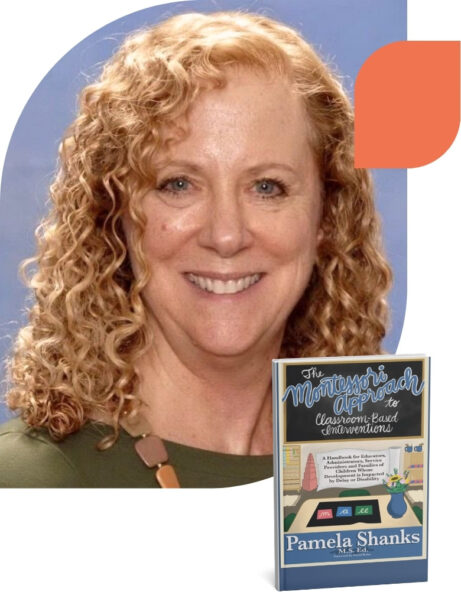
Pamela Shanks
Pam Shanks, M.S. Ed. (she/her), specializes in inclusive Montessori education. She provides professional development and consultative services for Montessori schools and teachers serving children whose learning or development differs from their peers. Facilitating the connection between Montessori and every child is the focus of her work.
During her 30+ years in Montessori education, Pam has worked as a teacher, administrator, coordinator of a schoolwide inclusion program, and mentor for Montessori and special education teachers/interns. These experiences have culminated in a deep understanding of the Montessori method, inclusive schools, and inclusive education.
Pam's newest book is "The Montessori Approach to Classroom-Based Interventions: A Handbook for Educators, Administrators, Service Providers, and Families of Children Whose Development is Impacted by Delay and Disability" foreword by David Kahn. In it, she draws on her extensive experience as a Montessori educator to offer a powerful, research-informed handbook for supporting children with developmental differences. Blending time-tested Montessori principles with modern educational strategies, this comprehensive resource provides educators, administrators, service providers, and families with the tools they need to create respectful, inclusive, and dynamic learning environments. This handbook is an indispensable companion for anyone dedicated to helping all children reach their fullest potential. It is available on Amazon and from Parent Child Press, a division of Montessori Services.
Discussion
Your questions will be answered after the conference.
Add a comment
You must be logged in to post a comment.
I teach in a lower elementary classroom. I have a child who is coming this year with ADHD but also he has a speech issue where he is just finally started speaking but he could not really say any words. Could I do for them when the mother really is pushing a child to know not only to speak English but their home language plus Spanish and French. He is slowly doing spelling words with the storyboard alphabet. Any suggestions?
Thank you for the question, Val! My answer is based on my understanding of this child’s experience given the understandably limited information above.
It sounds like this child is a multilingual learner. It is quite normal for children who are learning multiple languages at the same time to be a bit behind in all languages initially. This is entirely normal. it would also be normal for a child who is fluent in one or more languages and beginning to learn the language of your school to experience difficulty with the new language. In these cases, the mother’s desire for learning other languages should not be a problem.
If the child does not have typically developing language in any of the languages you mentioned, that is a larger problem. It would likely require help from professional(s) and the use of specialized techniques outlined in Chapter 6 on developmental language differences in my book.
My answer below assumes that the child is fluent in one or more languages and just beginning to learn the language of your school. If you have ever taken language classes, I’d encourage you to reflect on that experience. What helped you learn? What made it harder? You may find some answers in your own experience.
Here are a few of my top tips :):
1. Build a strong connection with this child. Learning will be hard and tiring. It will require focused attention, something that he already struggles with. Building a bond will help this child feel supported, maintain motivation, and put in the effort required. (Chapter 9 of my book covers ADHD and how to help in the classroom).
2. Slow down your rate of speech, especially during one-on-one interactions, lessons, and follow-up help. Slowing down supports children’s understanding, learning, and the ability to repeat and use new vocabulary.
3. Be concise, again especially during one-on-one interactions, lessons and follow-up help. For example, you might say, “Alright, we are going to have a lesson on the equilateral triangle today so let’s go get the tray.” To be more concise, insted say something like, “Time for a lesson. We need the equilateral triangle. Let’s go!” Being concise helps children focus on the essential language in a spoken message.
4. Repeat important vocabulary as frequently as possible. For example, you might say, “This is the equilateral triangle. It has 3 sides. Its side are all the same length.” However for this child, say something like, “This is an equilateral triangle. An equilateral triangle has 3 sides. The sides of an equilateral triangle are the same length.” Using the vocabulary “equilateral triangle” repeatedly helps the child to focus on the essential language of the lesson.
5. Take advantage of the materials. Still thinking of the introduction to an equilateral triangle, place the it inside the frame, pick it up, rotate, replace it in the frame. Repeat this several times while saying, “The same length” each time. Trace each side of the equilateral triangle saying the same thing. Place the triangle in the frame, leave it there, and trace each side saying the same thing. Let the child try each of your demonstations of “same length” after each. The concrete nature of this experience enhances learning.
6. Connect learning to the environment. So, if the child is learning to spell square, allow him to do that and then write it on a slip of paper. Walk around the room, occasionally saying, “square…find a square…” When you find one, announce, “A square flower pot!” Take the square back to the rug or table and lay the slip of paper next to it. Let the child try. You can review the child’s work by saying, “You found a square lid.” “Your found a square mat.” “You found a square box.” “You found the square of 5.” etc. The repetition of this work is helpful to a language learner, and as a bonus, it might help with his need to move if his ADHD manifests with extra movement. I hope this is helpful. Please feel free to reach out to me at classroombasedinterventions@gmail.com if you have more questions or need more help.
Warmly,
Pam
I enjoyed hearing the lecture and learnt more about the principles of Montessori teaching all children life skill for learning and hope to children who struggle.
We are seeing more children struggling with ADHD and autism and Montessori education able to support families and the whole community.
Hi Heather,
You are not alone. Schools everywhere are experiencing the same thing.
That need got me started writing. As I presented, people would come up afterwards to ask about “this one child.” Universally I find that Montessori teachers want to serve all children, but they often struggle with the what to do. I wrote my book to address that struggle.
I’m so glad that you enjoyed the presentation and excited that you feel like you learned something :)! Please feel free to reach out to me with any questions at:
classroombasedinterventions@gmail.com
Best wishes!
Pam