
Lynda Apostol
The Prepared Adult in Language Development
Join Lynda Apostol, Montessori homeschool expert and author, as she shares how the prepared adult plays a vital role in language development within Montessori education. With 20 years of experience, Lynda shows us that language development goes beyond vocabulary, it’s about building real, meaningful connections.
In this session, you’ll learn about:
- The neurological and creative aspects of language
- Why immersion matters more than direct instruction
- How our tone, actions, and behavior shape children’s language development
Lynda also offers practical tips like how to define, describe, and notice with children every day, the importance of daily language rituals, and how to create emotionally safe spaces for children to thrive. She’ll wrap up with powerful insights on how storytelling, narration, and listening build not just language skills, but emotional security too.
AUDIO VERSION
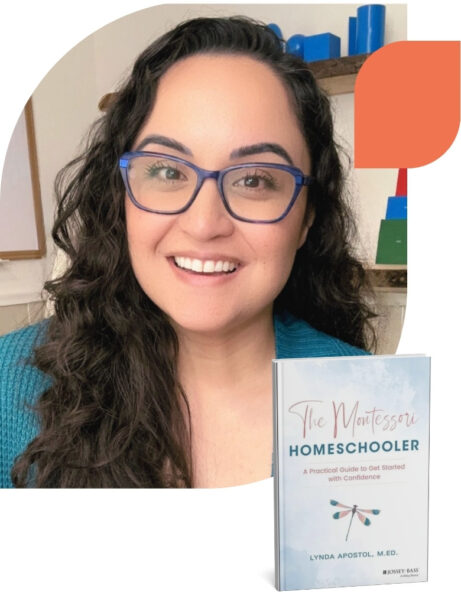
Lynda Apostol
Lynda Apostol (M.Ed) is the voice, coach & influence behind The Montessori Teacher, LLC. Her professional experience includes roles as a teacher, instructional coach and administrator in the public, private, and charter education sectors in both Montessori and Traditional approaches. She credits both her education and the diversity in her experience for lending her an unmatched perspective and informed understanding of curriculum & instruction as it applies not only to the child, but the guide/teacher.
Lynda now homeschools both of her children and serves as a highly sought-after Holistic Montessori Coach to parents around the world seeking to homeschool or worldschool with the Montessori Method. She also supports educators and educational organizations as a speaker & Holistic Education Consultant.
Lynda’s social media platforms seek to inform, educate and advocate toward a long-term vision of creating more inclusive Montessori cyberspaces that celebrate diversity and promote the global perspective with cultural competence. Lynda is also the author of "The Montessori Homeschooler".
Discussion
Your questions will be answered after the conference.
Add a comment
You must be logged in to post a comment.
The adults preparations are very important. To assist all children. I like the connection between art and science is language.
Absolutely! Language is not just a skill set. It’s not merely vocabulary, articulation, or phonemic awareness. Language is both art and science, and the adult has to be prepared for both roles simultaneously.
How do you get a teacher to stop baby talk to the children ?
My honest answer is: you don’t.
And more importantly: you can’t.
One of the hardest paradigm shifts for parents (and educators) is accepting the limits of control. We live in a culture that quietly teaches us that if something isn’t aligned with our values, we should correct it, manage it, or fix it. But Montessori (done honestly) asks us to start by understanding circles of influence.
You have influence toward others (a few), but you do not have control.
Other adults (teachers, grandparents, caregivers, extended family)msit outside your circle of control. Even your own children are outside of it. That doesn’t mean their behavior doesn’t matter. It means the strategy about how you approach it and how you understand it must change.
Not all adults hold the same developmental weight in a child’s life. Parents have disproportionate influence because of proximity, attachment, consistency, and modeling. A grandparent does not shape language, identity, or inner speech the way a parent does. A substitute teacher does not carry the same imprint as a primary guide. A weekly class does not override the daily environment. this distinction matters.
Sometimes we, as parents, fixate on correcting every adult around our child, without realizgin how often we overestimate the impact of peripheral influences and underestimate their own power. The child’s nervous system is far more attuned to the adult they live with, observe daily, and feel safest with than to occasional speech patterns elsewhere.
To be clear: this doesn’t mean you stay silent. You can have an honest, respectful conversation with the teacher to voice your concerns and share how you approach this in alignment with your values. You can share why clear, respectful language matters to you and you can certainly set boundaries where appropriate (when your child is learning a new lesson, for example). But you cannot “get” someone to change. And trying to do so often costs more than it gives—emotionally, relationally, and energetically.
What you can focus on is this:
1) Model the language you want your child to internalize.
2) Speak clearly, respectfully, and with trust in their capacity.
3)Hold the line consistently in your own presence.
Children are remarkably good at contextual learning. They understand that different adults speak differently, hold different expectations, and occupy different roles. This does not confuse them nearly as much as adults fear. In fact, it’s part of how they learn social nuance and discernment.
The deeper work here isn’t correcting others. It’s tolerating difference without panic, trusting your own influence, and letting go of the illusion that alignment everywhere is necessary for healthy development.
Living Montessori principles doesn’t require trained adults everywhere a child goes. It’s about learning and knowing where your responsibility ends, and where your steadiness begins.
Thank you so much for that response. I received an answer on my current questions through reading it.
It is indeed emotuonally draining to try to get someone to change. Thank you for reminding about real place of focus.
Thank you, Linda, for your lecture on the science of language. The importance of the adult, environment and the child. I enjoyed hearing about storytelling and reading book to the children and, modeling reading to children.